Blog Articles

Explore the latest news, updates, and practical guides.

Longer LK4 Pro & LK5 Pro – Upgrades by @Ciubecca - LONGER

Longer LK4 Pro & LK5 Pro – Upgrades by @Ciubecca

All Longer 3D printers offer excellent performance and guarantee high print quality, however some users love to install upgrades useful to change the aesthetic appearance or characteristics of the printer. For this reason,。 this article intends to present...
Leer más
First Layer Calibration - LONGER

First Layer Calibration

The calibration of the first layer takes place by calibrating the distance between the tip of the nozzle and the surface of the printing plate; in this way the extruded plastic will stick correctly to the plane, being...
Leer más
Printing Flow Calibration - LONGER

Printing Flow Calibration

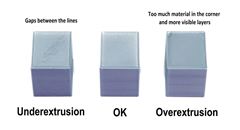
In 3D printing, extrusion flow is a key aspect to consider if you want to obtain not only quality prints, but also dimensionally correct prints. The flow is closely related to the speed of rotation of the gear...
Leer más
Bridging Printing

Bridging Printing

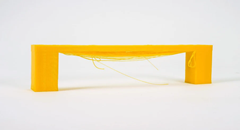
The FDM 3D printing consists of a series of layers of molten material placed on top of each other; in this way, complex objects are created through a succession of layers. However, often some layers must be placed...
Leer más
Printing Supports - LONGER

Printing Supports

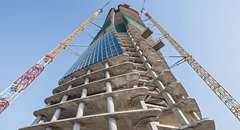
FDM 3D printing consists of a series of layers of molten material placed on top of each other; in this way, complex objects are created through a succession of layers. However, often some layers must be placed in...
Leer más
Nozzle Size Comparing - LONGER

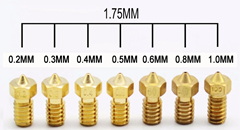
3D Printer Nozzle Size Comparing: Speed, Detail & Layer Height Explained

In 3D printing, the nozzle diameter plays a key role in determining the maximum layer height you can use. As a general rule, the maximum layer height is about 80% of the nozzle’s diameter. For example:

  • With a 0.4 mm nozzle, the layer height can go up to 0.32 mm.

  • With a 0.8 mm nozzle, it can reach 0.64 mm.

  • With a 0.2 mm nozzle, the maximum is 0.16 mm.

What’s important to note is that the nozzle size only limits the maximum layer height — not the minimum. This means that even with a large 0.8 mm nozzle, you can still print with fine resolutions like 0.05 mm, just as you would with smaller nozzles.

In simple terms, larger nozzles allow faster printing while still being capable of high detail, and smaller nozzles focus on fine detail but print more slowly.

Leer más
Tolerance Test for Joints - LONGER

Tolerance Test for Joints

When creating laser-cut assemblies, one of the most common challenges is achieving the correct fit between connected parts. A tolerance test for joints helps determine whether pieces fit too tightly, too loosely, or exactly as intended. Running this...
Leer más